


Dealership blog
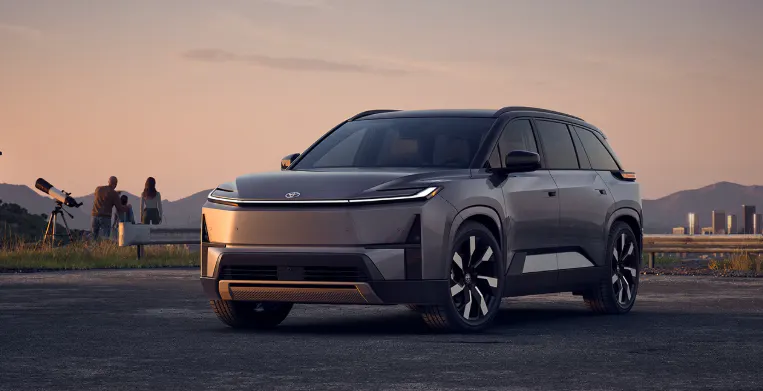
2028 Toyota Highlander: First Look at Toyota’s All-Electric Redesign for Mobile-Area Families
Springhill Toyota Highlander Guide
What Mobile Families Can Expect: Three Rows, Zero Emissions, and Everyday Versatility
See what Toyota has confirmed for the all-electric 2028 Toyota Highlander (first announced as the 2027 Highlander), including range, seating, and Toyota Safety Sense 4.0.
Quick Answer: What Is New on the Redesigned Toyota Highlander?
The redesigned Toyota Highlander is a fifth-generation, all-electric three-row SUV, and Toyota’s U.S. newsroom describes it as Toyota’s first three-row battery-electric vehicle for the U.S. market. Toyota first announced it as the 2027 Highlander and now lists it as the 2028 Toyota Highlander, with sales expected to begin in early 2027 for the XLE AWD and Limited AWD models with the 95.8-kWh battery, and in mid-2027 for the XLE FWD with the 77.0-kWh battery. Toyota’s manufacturer-estimated total driving range runs from 270 to 315 miles depending on battery size and drivetrain, and U.S. pricing will be announced closer to the on-sale date.
If you searched for the 2027 Toyota Highlander, this is the same vehicle. The sections below cover what Toyota has confirmed for the U.S. market, how it differs from the Highlander and Highlander Hybrid you may already know, and what it could mean for daily driving around Mobile and Baldwin County.
Toyota Highlander Definition
Definition: The Toyota Highlander is a three-row midsize SUV built for families who need seating for up to seven passengers along with cargo space for daily errands and longer trips. The redesigned fifth-generation Highlander is battery-electric, with front-wheel-drive and all-wheel-drive versions and a standard NACS charging port. For Mobile-area families, the practical implication is a Highlander that is charged at home or at a public station rather than filled at a gas pump, which changes how it fits into a household’s weekly routine.
Table of Contents
- Quick Answer: What Is New on the Redesigned Toyota Highlander?
- Toyota Highlander Definition
- Confirmed U.S. Specs and Features
- How the All-Electric Highlander Compares to the Current Highlander
- What an Electric Highlander Means for Mobile and Baldwin County Driving
- A Rough Look at Charging Cost vs. Gas Cost
- What Toyota Has Not Announced Yet
- Talk to Our Team About the Highlander
- Key Takeaways
- FAQ
Confirmed U.S. Specs and Features
Everything in this section comes from Toyota’s U.S. announcement. Range figures are manufacturer-estimated, which means they are Toyota’s own estimates rather than EPA-certified ratings, and actual range varies with driving conditions, temperature, load, and charging habits.
Powertrain and output
Toyota offers the redesigned Highlander in two grades, XLE and Limited. The XLE is available with front-wheel drive (77.0-kWh battery) or all-wheel drive (77.0-kWh or 95.8-kWh battery). The Limited comes only with all-wheel drive and the 95.8-kWh battery. All-wheel-drive versions produce 338 total system horsepower, and the front-wheel-drive XLE produces 221 total system horsepower.
Driving range (manufacturer-estimated)
The table below lines up each configuration Toyota has announced, with its battery, output, estimated range, and expected on-sale timing.
| Grade | Drivetrain | Battery | Total System Horsepower | Manufacturer-Estimated Range | Expected On Sale |
|---|---|---|---|---|---|
| XLE | Front-wheel drive | 77.0 kWh | 221 hp | 287 miles | Mid-2027 |
| XLE | All-wheel drive | 77.0 kWh | 338 hp | 270 miles | Not stated |
| XLE | All-wheel drive | 95.8 kWh | 338 hp | 315 miles | Early 2027 |
| Limited | All-wheel drive | 95.8 kWh | 338 hp | 315 miles | Early 2027 |
Toyota labels these figures as estimates only, so treat them as a planning guide until EPA ratings are published.
Toyota’s U.S. newsroom lists the redesigned Highlander in XLE and Limited grades with 77.0-kWh or 95.8-kWh batteries, up to 338 total system horsepower with all-wheel drive, and manufacturer-estimated driving range of 270 to 315 miles. It seats up to seven, offers 45.6 cubic feet of cargo space with the third row folded and 15.9 cubic feet with it up, and comes standard with Toyota Safety Sense 4.0 and a NACS charging port. Toyota says DC fast charging can take the battery from 10% to 80% in around 30 minutes under ideal conditions.
Charging
The Highlander has a standard NACS port, an 11-kW onboard AC charger on the XLE, and a dual-voltage 120V/240V charging cable included with the vehicle. NACS is the connector standard Tesla developed, and Toyota’s announcement presents it as the Highlander’s standard port. Toyota also lists preconditioning and Plug & Charge, with Plug & Charge requiring a Remote Connect trial or subscription.
Seating, cargo, and size
Second-row captain’s chairs are standard, and an available bench seat (XLE AWD only) brings seating to seven. The third row fits two adults. The Highlander is 198.8 inches long on a 120.1-inch wheelbase, and Toyota builds it in Georgetown, Kentucky.
Grades and standard equipment
The XLE and Limited differ mainly in comfort and driver-assistance equipment, summarized below.
| Feature | XLE | Limited |
|---|---|---|
| Touchscreen and gauge cluster | 14-inch touchscreen, 12.3-inch digital gauge cluster | Same |
| Wheels | 19-inch | 22-inch available |
| Seating comfort | Heated front seats, heated steering wheel, SofTex seating | Adds ventilated front seats and heated second row |
| Driver assistance | Toyota Safety Sense 4.0, parking assist with automatic braking, drive recorder | Adds Panoramic View Monitor, Advanced Park, Lane Change Assist, Front Cross Traffic Alert |
| Other | Regenerative-braking paddle shifters | Adds head-up display, memory mirrors, rear sunshades |
Toyota also lists a panoramic roof, a JBL 11-speaker audio system (XLE AWD and Limited), and two-tone paint (Limited) as options. Vehicle-to-load (V2L) capability is available, with the bi-directional accessories sold separately.
How the All-Electric Highlander Compares to the Current Highlander
If you have researched the current Highlander or Highlander Hybrid, the important point is that the redesigned model is not an updated version of that vehicle. It uses a different powertrain architecture entirely, so none of the current Highlander’s gas mileage, hybrid system details, engine specifications, or trim lineup carry over. Toyota’s gas and hybrid three-row option in the lineup is the Grand Highlander.
That distinction matters for a few practical reasons. First, ownership looks different: charging at home or at a public station replaces filling up at a gas station, which is a bigger adjustment than moving between a gas Highlander and a Highlander Hybrid, since both of those still use gasoline. Second, the manufacturer-estimated range figures above will determine how the Highlander fits routines that include longer regional drives, such as trips up I-65 or across to Pensacola. Third, because Toyota has not yet announced U.S. pricing, a dollar-for-dollar comparison with the current gas or hybrid model is not possible yet.
For a Mobile-area family deciding whether to wait for the all-electric Highlander or buy a current-generation Highlander or Highlander Hybrid now, the decision comes down to two questions: whether home or workplace charging is realistic for your household, and whether you need a vehicle before the early-to-mid 2027 on-sale window. If charging is not practical for your daily routine, a current gas or hybrid three-row SUV keeps the fueling habits you already have. If you can charge regularly and are not in a hurry, waiting for U.S. pricing and EPA-rated range gives you the numbers you need to compare the two.
The table below sets the redesigned Highlander next to the current Highlander and Highlander Hybrid so the scope of the change is easy to see.
| Attribute | Current Highlander / Highlander Hybrid | Redesigned All-Electric Highlander |
|---|---|---|
| Powertrain | Gas four-cylinder or hybrid system | Battery-electric only |
| Fueling | Gasoline | Home or public charging, NACS port |
| Seating | Up to 8 passengers, depending on trim | Up to 7 passengers |
| Safety suite | Toyota Safety Sense, generation varies by model year | Toyota Safety Sense 4.0, standard |
| U.S. pricing | Published on Toyota.com | Announced closer to on-sale date |
| Range or efficiency | EPA-rated MPG | Manufacturer-estimated range, 270 to 315 miles |
What an Electric Highlander Means for Mobile and Baldwin County Driving
Consider a family in Spanish Fort with a Highlander on their shortlist. Their routine includes school drop-off close to home, a commute into Mobile across the Bayway, and occasional weekend trips to Gulf Shores or Orange Beach, roughly 40 miles one way. None of those trips would be unusual for an EV with a manufacturer-estimated range of 270 to 315 miles, even allowing for the fact that real-world range is usually lower than an estimate, especially with the air conditioning running through a Gulf Coast summer.
The bigger practical question for that family is charging rather than driving. A home Level 2 charger is the most realistic setup for a household that drives an electric Highlander daily, since public fast charging along I-10 and I-65 should not be assumed to work like a gas station network. Families who travel to Mississippi or the Florida Panhandle should plan a charging stop into longer drives rather than assuming they can go the full distance and back, particularly with a full load of passengers and cargo.
None of this is a reason to avoid the redesigned Highlander. It is a reason to think through charging access before ordering one, the same way a shopper would think through towing needs before buying a truck.
A second scenario: a Baldwin County household in Daphne or Fairhope with a commuter who drives into downtown Mobile across the Bayway most weekdays, roughly a 20 to 25 mile round trip, plus weekend errands. That routine sits well inside every range estimate Toyota has published, including the 270-mile figure for the shorter-range AWD configuration, and it fits charging at home once or twice a week rather than daily. The exception worth planning for is hurricane season. If an evacuation ever requires a long drive north on I-65 on short notice, a household with an electric Highlander should keep the battery topped off during storm watches, the same way we would recommend keeping a gas tank full.
A Rough Look at Charging Cost vs. Gas Cost
This is an illustrative estimate, not a quote. Toyota has not published U.S. energy-consumption figures for the Highlander, so this estimate divides battery capacity by manufacturer-estimated range, which gives roughly 0.28 to 0.30 kilowatt-hours per mile. For 1,000 miles a month, a mix of local errands and a daily commute, that works out to about 300 kilowatt-hours before charging losses.
Electricity prices vary by utility, rate plan, and time of day, and public charging usually costs more per kilowatt-hour than charging at home. The table compares three assumed home electricity prices against a gas-powered midsize SUV averaging 24 combined MPG at three assumed gas prices, so you can substitute the prices on your own bills.
| Monthly Cost at 1,000 Miles | Low Assumption | Mid Assumption | High Assumption |
|---|---|---|---|
| Electric Highlander at home (about 300 kWh) | About $36 at $0.12/kWh | About $42 at $0.14/kWh | About $48 at $0.16/kWh |
| Gas midsize SUV (about 42 gallons at 24 MPG) | About $115 at $2.75/gal | About $125 at $3.00/gal | About $135 at $3.25/gal |
The gap narrows for households that do most of their charging at public stations, and it can widen for households that charge overnight on a lower-priced rate where one is available. The point is not to promise a specific savings number. It is to show that charging cost for typical Mobile-area driving is straightforward to calculate once you know your own electricity rate, and that it will be easier to refine once Toyota publishes EPA efficiency ratings.
What Toyota Has Not Announced Yet
Toyota has released a detailed set of specifications, but several details that matter to a purchase decision are still pending for the U.S. market:
- U.S. pricing for each grade and battery configuration
- EPA-certified range and efficiency ratings
- Towing capacity
- Battery and electric-drivetrain warranty terms for this generation
- Level 2 charging times and DC fast-charging peak power
- Exact on-sale dates for individual dealerships
The table below separates what is settled from what is still to come.
| Category | Status |
|---|---|
| Battery-electric powertrain, XLE and Limited grades | Announced |
| Battery sizes, horsepower, and manufacturer-estimated range | Announced |
| Seating, cargo volume, Toyota Safety Sense 4.0, NACS port | Announced |
| DC fast charging, 10% to 80% in around 30 minutes (ideal conditions) | Announced |
| Early 2027 on-sale for XLE AWD and Limited AWD (95.8 kWh); mid-2027 for XLE FWD | Announced timing, not a delivery date |
| U.S. pricing | Coming closer to on-sale date |
| EPA range, towing capacity, warranty terms | Not announced |
Talk to Our Team About the Highlander
If you are weighing whether to wait for the all-electric Highlander or move forward with a current Highlander, Highlander Hybrid, or Grand Highlander, our sales team can walk through what Toyota has announced and help you compare it against the vehicles available today. If you are currently driving a gas or hybrid Highlander, our team can also provide a trade-in valuation for your current vehicle, the same way we would for any other trade-in. Reach us at 251-450-1000, or check our current new Toyota inventory to see what is available while you wait.
Key Takeaways
- The redesigned Toyota Highlander is a fifth-generation, battery-electric three-row SUV, first announced as the 2027 Highlander and now listed by Toyota’s U.S. newsroom as the 2028 Toyota Highlander.
- Toyota offers XLE and Limited grades, with 77.0-kWh or 95.8-kWh batteries and up to 338 total system horsepower with all-wheel drive.
- Toyota’s manufacturer-estimated range is 270 to 315 miles, with the 315-mile figure on the 95.8-kWh XLE AWD and Limited AWD.
- Seating is up to seven, cargo space is 45.6 cubic feet with the third row folded, and Toyota Safety Sense 4.0 and a NACS port are standard.
- Sales are expected to begin in early 2027 for the 95.8-kWh models and mid-2027 for the XLE FWD; U.S. pricing comes closer to on-sale.
- None of the current gas or hybrid Highlander’s specifications carry over to this generation.
Quick Answers Before You Visit
Is it the 2027 or the 2028 Toyota Highlander?
It is the same vehicle. Toyota first announced the all-electric Highlander as a 2027 model, and its U.S. newsroom now lists it as the 2028 Toyota Highlander, with sales expected to begin in early 2027 as a 2028 model-year vehicle.
When can I buy the all-electric Highlander at Springhill Toyota?
Toyota expects the XLE AWD and Limited AWD with the 95.8-kWh battery to go on sale in early 2027 and the XLE FWD with the 77.0-kWh battery in mid-2027. Exact timing at any individual dealership, including ours, depends on Toyota’s production and shipping, so contact our sales team for the latest information.
How far can the redesigned Highlander drive on a full charge?
Toyota’s manufacturer-estimated total driving range is 287 miles for the XLE FWD, 270 miles for the XLE AWD with the 77.0-kWh battery, and 315 miles for the XLE AWD with the 95.8-kWh battery and for the Limited AWD. These are not EPA-certified ratings, and actual range varies with driving conditions, climate control use, and load.
Do I need a home charger to own the redesigned Highlander?
Toyota includes a dual-voltage 120V/240V charging cable, so you can charge from a standard outlet or a 240-volt outlet. For a daily family vehicle, a home Level 2 charger is the most practical way to keep the battery ready, since relying only on public charging along the Gulf Coast is less predictable than fueling a gas vehicle.
Plan Your Highlander Decision in Mobile, AL
The redesigned Toyota Highlander moves one of Toyota’s most popular family SUVs to an all-electric powertrain while keeping the three-row seating and cargo space families expect. With U.S. pricing and EPA ratings still to come, the most useful next step for most Mobile-area shoppers is deciding whether charging fits their routine, then staying in touch with our team as Toyota releases more information. In the meantime, our team can help you compare the current Highlander, Highlander Hybrid, and Grand Highlander. Visit us at 3062 Government Boulevard in Mobile or call 251-450-1000.
Helpful Springhill Toyota Links
Related Articles
Keep reading more Toyota shopping, ownership, and Gulf Coast driving guides from Springhill Toyota.
Family SUV Guide
Introducing the 2026 Toyota Highlander: Trim Levels and Key Features
Review the current-generation Highlander trim levels and key features before comparing them with the all-electric redesign.
Family SUV Guide
Why Mobile Families Are Choosing the 2026 Toyota Grand Highlander Hybrid
See how the Grand Highlander Hybrid fits Mobile-area families who want three-row seating today.