


Dealership blog
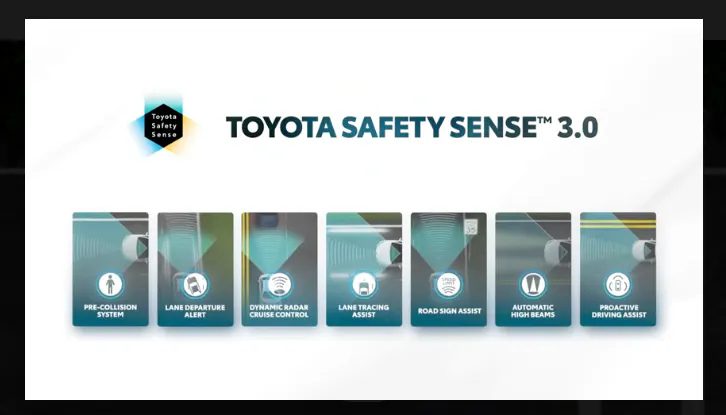
Toyota Safety Sense Explained: What’s Included on Current Toyota Models
Springhill Toyota Safety Technology Guide
Core Active Safety Features: How Pre-Collision, Lane Tracing, and Radar Cruise Work
See what Toyota lists in Toyota Safety Sense 3.0 and 4.0, which current Toyota models carry each generation, and what the systems do and do not do.
Quick Answer: What Does Toyota Safety Sense Include?
Toyota Safety Sense is Toyota’s suite of driver-assistance features, and Toyota’s U.S. releases list it in different generations by model. The 2026 RAV4, 2027 Tundra, 2027 Sequoia, and the all-electric 2028 Highlander carry Toyota Safety Sense 4.0, while the 2026 Camry, Crown, Tacoma, 4Runner, and Grand Highlander, and the 2027 Corolla Hatchback, Corolla Cross, and Grand Highlander carry Toyota Safety Sense 3.0. The 2026 Sienna carries Toyota Safety Sense 2.0. Toyota’s releases list the same seven core features for 3.0 and 4.0, and Toyota describes 4.0 as adding updates to hardware and detection capabilities.
Generation depends on the model and model year, and sometimes on trim, so the most reliable way to know what a specific vehicle includes is to check its window sticker or ask our team. This article covers what Toyota has published, how the generations compare, and how the systems behave on Gulf Coast roads.
Toyota Safety Sense Definition
Definition: Toyota Safety Sense is a package of driver-assistance features on current Toyota models, built around a forward camera and radar that monitor the road ahead and help with following distance, lane position, and potential collisions. It is not a self-driving system and is designed to support an attentive driver rather than replace one. For Mobile-area drivers, the practical implication is a layer of added safety technology on many new Toyotas, with exact features and generation varying by model and model year.
Table of Contents
- Quick Answer: What Does Toyota Safety Sense Include?
- Toyota Safety Sense Definition
- What Toyota Lists in Toyota Safety Sense 3.0
- What Toyota Lists in Toyota Safety Sense 4.0
- Which Current and 2027 Models Have Which Generation
- How Much Does the Generation Matter?
- What Toyota Safety Sense Does Not Do
- Driving Mobile and Baldwin County Roads with Toyota Safety Sense
- Confirming Your Vehicle’s Exact Features
- Key Takeaways
- FAQ
What Toyota Lists in Toyota Safety Sense 3.0
Toyota’s U.S. releases for models that carry Toyota Safety Sense 3.0, including the 2026 Camry, Crown, Tacoma, 4Runner, and Grand Highlander, list the following features:
- Pre-Collision System with Pedestrian Detection
- Full-Speed Range Dynamic Radar Cruise Control
- Lane Departure Alert with Steering Assist
- Automatic High Beams
- Lane Tracing Assist
- Road Sign Assist
- Proactive Driving Assist
The 2026 Grand Highlander release also lists the Emergency Driving Stop System, and Toyota’s owner’s manual has a section for it under the Toyota Safety Sense 3.0 heading, marked “if equipped.” Whether it is included depends on the model, so confirm it for the exact vehicle.
A few of these features are easy to misunderstand from the name alone. Road Sign Assist does not control the vehicle. It reads posted signs and shows them on the display, which can be useful on unfamiliar roads where a sign is partly hidden by vegetation, as it can be on rural Alabama roads. Proactive Driving Assist is the feature many drivers notice without knowing the cause, such as gentle deceleration when approaching a curve or when the vehicle ahead slows down. The Emergency Driving Stop System, where equipped, is designed for a genuine emergency, such as a driver who becomes unresponsive, rather than for everyday driving.
What Toyota Lists in Toyota Safety Sense 4.0
Toyota’s U.S. releases for the 2026 RAV4, 2027 Tundra, 2027 Sequoia, and 2028 Highlander list seven Toyota Safety Sense 4.0 features: Pre-Collision System with Pedestrian Detection, Full-Speed Range Dynamic Radar Cruise Control, Lane Departure Alert with Steering Assist, Automatic High Beams, Lane Tracing Assist, Road Sign Assist, and Proactive Driving Assist. Toyota lists these same seven features for Toyota Safety Sense 3.0 models, and it describes the 4.0 generation as having updates to its hardware and detection capabilities. Blind Spot Monitor appears separately in those releases, and the Emergency Driving Stop System is not listed in any of the 4.0 releases.
The table below compares what Toyota’s releases list for each generation.
| Feature | Toyota Safety Sense 3.0 | Toyota Safety Sense 4.0 |
|---|---|---|
| Pre-Collision System with Pedestrian Detection | Listed | Listed |
| Full-Speed Range Dynamic Radar Cruise Control | Listed | Listed |
| Lane Departure Alert with Steering Assist | Listed | Listed |
| Automatic High Beams | Listed | Listed |
| Lane Tracing Assist | Listed | Listed |
| Road Sign Assist | Listed | Listed |
| Proactive Driving Assist | Listed | Listed |
| Emergency Driving Stop System | Listed on the 2026 Grand Highlander and in the owner’s manual under 3.0 | Not listed in the 4.0 releases |
Toyota has not published a feature-by-feature comparison of the two generations on the U.S. pages used for this article, so this table shows what Toyota lists, not a measure of how each performs. Features and sensitivity can also vary by trim.
How the system senses the road
The systems rely on a forward camera mounted near the rearview mirror and a radar unit at the front of the vehicle. The camera reads lane markings, signs, and shapes such as vehicles and pedestrians, while the radar measures distance and closing speed to objects ahead. The vehicle combines data from both to decide when to warn you or apply the brakes. That is why the glass in front of the camera and the bumper area that houses the radar matter after any repair. Toyota’s owner’s manual states that if the windshield has been replaced, the front camera must be recalibrated, and that radar recalibration is needed after front bumper or grille replacement. It directs owners to a Toyota dealer for the work, and your vehicle’s own manual has the instructions for your model.
Which Current and 2027 Models Have Which Generation
The table below lists the generation named in Toyota USA’s release for each model.
| Model | Model Year | Toyota Safety Sense Generation |
|---|---|---|
| RAV4 | 2026 | 4.0 |
| Tundra | 2027 | 4.0 |
| Sequoia | 2027 | 4.0 |
| Highlander (all-electric) | 2028 | 4.0 |
| Camry | 2026 | 3.0 |
| Crown | 2026 | 3.0 |
| Tacoma | 2026 | 3.0 |
| 4Runner | 2026 | 3.0 |
| Grand Highlander | 2026 and 2027 | 3.0 |
| Corolla Hatchback | 2027 | 3.0 |
| Corolla Cross | 2027 | 3.0 |
| Sienna | 2026 | 2.0 |
Two details are easy to miss. The all-electric Highlander is listed as a 2028 model in Toyota’s newsroom, though it was first announced as the 2027 Highlander. And the 2026 Sienna carries Toyota Safety Sense 2.0, so the minivan is not on the same generation as the other models. This table covers the models Toyota’s releases name, not every vehicle in our inventory, so use the window sticker to confirm a specific vehicle.
How Much Does the Generation Matter?
Because Toyota lists the same seven core features for Toyota Safety Sense 3.0 and 4.0, the generation number alone does not tell you which vehicle will behave better in your daily driving. Toyota describes 4.0 as updated hardware and detection, and Toyota has not published a feature-by-feature comparison on the U.S. pages used here, so the best way to compare two vehicles is to check which features each lists and to test the ones that matter to you on a test drive. If a specific capability is important, such as how radar cruise control behaves in stop-and-go traffic, confirm that feature on that exact vehicle and trim.
The Sienna is the clearest example of why the generation matters when you are shopping for a specific model. A family comparing a Sienna with another three-row vehicle should check the window sticker for each rather than assuming the same suite applies, and should ask our team to show them how each system is controlled from the steering wheel and display.
When you compare vehicles, a short list keeps the conversation practical. Start with the features that matter most to your daily drive, such as radar cruise control for highway commutes or Automatic High Beams for rural roads. Then confirm that each feature is on the exact trim you are considering, since equipment can differ by trim. Finally, ask how the system alerts you, because the style and sensitivity of warnings is something you can judge only from the driver’s seat. A test drive on roads you actually use, such as a stretch of I-10 or a Baldwin County two-lane road, will tell you more than a feature list can.
Some features, such as the Emergency Driving Stop System, appear in Toyota’s materials under one generation and not in the lists for another. If that feature matters to you, ask our team to confirm whether the vehicle you are considering has it.
What Toyota Safety Sense Does Not Do
Driver-assistance systems are sometimes misunderstood as more capable than they are. Toyota Safety Sense, in any generation, is not a self-driving system and does not remove the driver’s responsibility to stay attentive and be ready to take over. Features like Lane Tracing Assist and Proactive Driving Assist provide support rather than control, and driver input overrides them. They cannot handle every road condition, weather situation, or hazard on their own.
Heavy rain, fog, dirty or damaged sensors, and faded lane markings can all reduce how well camera- and radar-based systems work, and all are realistic on Gulf Coast roads at different times of year. If a message on the display says a system is unavailable, drive as though the feature is not there until it works again. Read your vehicle’s owner’s manual for the conditions in which Toyota says a feature may not operate properly.
Keeping the sensors working
Because the camera and radar need a clear view, a few habits help in a coastal climate. Keep the windshield clean, especially the area behind the rearview mirror, since salt haze, pollen, and road film build up quickly here. Keep the front of the vehicle free of mud, sand, and stickers, and avoid mounting accessories in front of the radar area. After a minor front-end impact, a repainted bumper, or a new windshield, ask about recalibration instead of assuming the system is fine. If a warning message appears, have it checked rather than waiting to see whether it clears.
| What to Check | Where to Find It |
|---|---|
| Which generation your vehicle has | Window sticker, owner’s manual, or our sales team |
| Which features are equipped | Owner’s manual section for your model year |
| When recalibration is needed | Owner’s manual and a Toyota dealer |
| What a dash message means | Owner’s manual or our service department |
Driving Mobile and Baldwin County Roads with Toyota Safety Sense
Consider a morning commute on I-65 or across the causeway into downtown Mobile, where traffic bunches up and speeds change quickly. Radar cruise control and Proactive Driving Assist can help maintain following distance in that kind of traffic, as long as the driver stays engaged. On a two-lane road in Baldwin County at night, Automatic High Beams and Lane Departure Alert may do more of the work, especially where lighting is inconsistent.
Heavy Gulf Coast rain deserves a direct mention. Camera- and radar-based systems can be less effective when the windshield or sensor area is wet or dirty, so in a serious downpour, treat the features as a supplement to lower speed and greater following distance rather than a reason to keep normal driving habits.
Towing is a third scenario for truck and SUV owners who haul boats to Dog River, Fowl River, or a ramp on the Eastern Shore. Towing changes stopping distance and handling, so check your owner’s manual for guidance on using radar cruise control and other driver-assistance features while towing, and rely on your own judgment about following distance.
| Driving Scenario | Features Most Relevant | Consideration |
|---|---|---|
| I-65 or causeway rush-hour traffic | Radar cruise control, Proactive Driving Assist | Can help maintain following distance; stay engaged |
| Rural Baldwin County roads at night | Automatic High Beams, Lane Departure Alert | More useful where lighting is inconsistent |
| Heavy Gulf Coast rain | All camera- and radar-based features | May be less effective; slow down and increase following distance |
| Towing a boat or trailer | Radar cruise control, Proactive Driving Assist | Check the owner’s manual for towing guidance |
| After a windshield or front bumper repair | Camera and radar | Toyota’s manual calls for recalibration after glass or bumper work |
Confirming Your Vehicle’s Exact Features
Toyota Safety Sense generation and features vary by model, model year, and sometimes trim, so the window sticker and our sales team are the most reliable references for a specific vehicle. If you are comparing two Toyota models with different generations, we are glad to walk through what each lists. Browse our current new Toyota inventory or call 251-450-1000 with questions about a specific model’s safety features. If your vehicle needs a windshield or front-end repair, our service department can answer questions about camera and radar recalibration.
Key Takeaways
- Toyota Safety Sense is a driver-assistance suite, not a self-driving system, and it appears in different generations depending on the model.
- Toyota’s releases list Toyota Safety Sense 4.0 on the 2026 RAV4, 2027 Tundra, 2027 Sequoia, and 2028 all-electric Highlander, and 3.0 on models including the 2026 Camry, Crown, Tacoma, 4Runner, and Grand Highlander.
- The 2026 Sienna carries Toyota Safety Sense 2.0.
- Toyota lists the same seven core features for 3.0 and 4.0 and describes 4.0 as updated hardware and detection, so compare features and test drive rather than relying on the version number.
- Toyota’s owner’s manual calls for front camera recalibration after a windshield replacement and radar recalibration after front bumper or grille replacement.
- Heavy rain, dirty sensors, and faded lane markings can reduce how well these systems work on Gulf Coast roads.
Quick Answers Before You Visit
Can I upgrade an older Toyota to a newer Toyota Safety Sense generation?
No. The system is built around cameras, radar, and computing hardware installed at the factory, so it cannot be upgraded to a newer generation after purchase. If a newer generation matters to you, that means buying a vehicle that carries it.
Does Toyota Safety Sense work the same in all weather conditions?
No. Camera- and radar-based systems can be less effective in heavy rain, fog, or when sensors are dirty or blocked. Reduce speed and increase following distance in poor conditions regardless of what the system detects.
Is Toyota Safety Sense the same as self-driving technology?
No. It is a driver-assistance suite that supports an attentive driver. Keep your hands on the wheel and stay ready to take control, whichever features are active.
Will a windshield replacement affect Toyota Safety Sense?
It can. Toyota’s owner’s manual says that if the windshield has been replaced, the front camera must be recalibrated. Ask the shop about recalibration before you leave, and confirm the procedure for your model in its owner’s manual or with a Toyota dealer.
Confirm Your Toyota’s Safety Features in Mobile, AL
Toyota Safety Sense gives many current Toyota models a layer of driver-assistance technology, and knowing which generation your vehicle carries sets realistic expectations. Whichever generation you drive, the guidance stays the same: let the system support your attention, especially in rain, heavy traffic, and towing situations that are part of life on the Gulf Coast. Keep the camera area of the windshield and the front radar area clean and undamaged, and have the camera recalibrated when the glass is replaced. If you want to compare the safety features of two vehicles side by side, visit Springhill Toyota at 3062 Government Boulevard in Mobile or call 251-450-1000.
Helpful Springhill Toyota Links
Related Articles
Keep reading more Toyota shopping, ownership, and Gulf Coast driving guides from Springhill Toyota.
Safety Guide
Toyota Safety Sense Overview
Springhill Toyota’s overview page for Toyota’s driver-assistance suite.