


Dealership blog
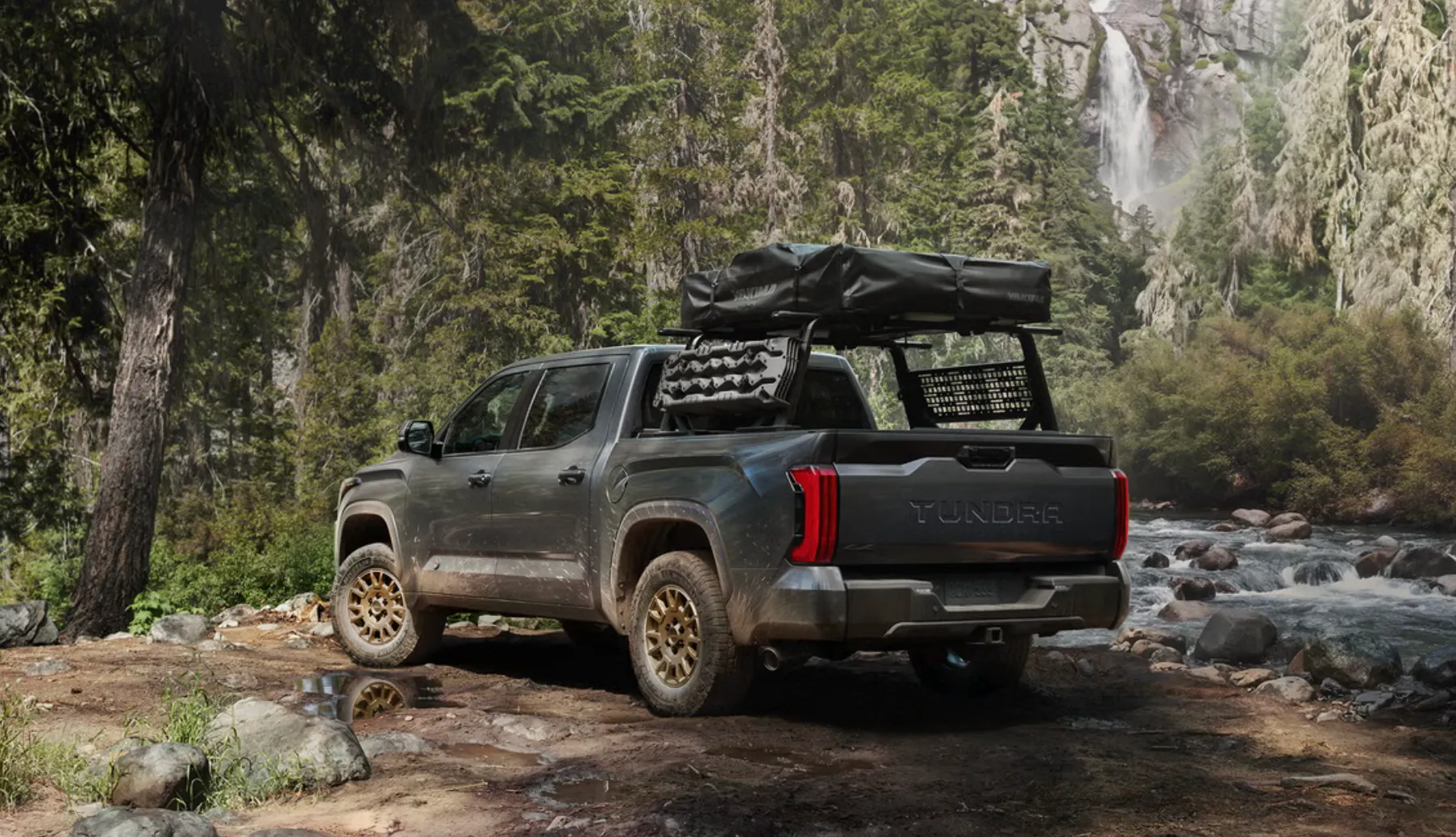
Tundra Trailhunter vs. TRD Pro: Which Off-Road Trim Fits Your Gulf Coast Needs?
Springhill Toyota Tundra Off-Road Comparison
Tundra Trailhunter vs. TRD Pro: Comparing Suspension, Tires, and Trail Hardware
Compare the 2027 Toyota Tundra Trailhunter package and TRD Pro on published equipment, with Gulf Coast towing, hunting-land, and boat-ramp use cases for Mobile drivers.
Tundra Trailhunter or TRD Pro: Which Fits Your Off-Road Plans?
The 2027 Toyota Tundra Trailhunter is a factory package based on the SR5, with Old Man Emu suspension, Michelin LTX Trail 265/70R18 tires, recovery-oriented equipment and added underbody protection. The TRD Pro is a separate grade, updated for 2027 with Tundra-tuned FOX QS3 shocks and red tow hooks. For deliberate low-speed trail use, the Trailhunter’s listed equipment gives you a useful starting point. For buyers particularly interested in adjustable shock behavior and a dedicated performance grade, the TRD Pro deserves a closer look.
Toyota’s November 5, 2026 announcement supplies more information than the preliminary July preview, including a $42,890 starting MSRP for the overall Tundra range and maximum towing of up to 12,000 pounds when properly equipped. Neither headline number tells you the price or tow rating of a specific Trailhunter or TRD Pro. Compare the exact trucks, their labels and available equipment rather than assuming the higher-priced grade is better off road. And remember that neither package makes flooded roads safe to cross.
Tundra Off-Road Packages Definition
Definition: A factory off-road package is a set of suspension, tire, protection, and traction equipment that a manufacturer installs and warrants as part of the vehicle, rather than parts added later by a shop. On the Toyota Tundra, the Trailhunter is a package built on the SR5 grade, and the TRD Pro is a dedicated grade with its own shocks and styling. For Gulf Coast drivers, the practical implication is that the equipment a truck needs for sand, mud, and rutted access roads can come from the factory.
Your Guide to Tundra Off-Road Equipment
- Tundra Trailhunter or TRD Pro: Which Fits Your Off-Road Plans?
- Tundra Off-Road Packages Definition
- What the Trailhunter Package Includes
- What the TRD Pro Includes
- Side-by-Side Equipment Comparison
- Two Different Approaches to Off-Road Driving
- Matching Each Package to Gulf Coast Driving
- Tires, Underbody, and Upkeep After Mud, Sand, and Salt
- Towing, Payload and Pricing: Check the Exact Truck
- How to Choose Between the Two
- Ask About Current Tundra Availability
- Key Takeaways
- Frequently Asked Questions
What the Trailhunter Package Includes
Toyota’s July 2026 announcement lists the following Trailhunter equipment for the 2027 Tundra:
| Component | Toyota’s Wording | What It Is Designed To Do |
|---|---|---|
| Suspension | Old Man Emu upgraded suspension | Handle uneven terrain and repeated off-road use |
| Tires | Michelin LTX Trail 265/70R18 | Balance highway manners with off-road traction |
| Wheels | Bronze-colored wheels | Visual identification; Toyota gives the tire size but no separate wheel specification |
| Recovery | Front recovery hooks | Provide an engineered attachment point for a recovery strap |
| Protection | Additional underbody protection | Shield vulnerable components from rocks and debris |
| Traction systems | Multi-Terrain Select, Crawl Control | Adjust throttle and braking response for sand, mud, and rock |
| Differential | Locking rear differential | Keep both rear wheels turning together for traction |
| Identification | Exclusive Trailhunter badges | Mark the package |
Toyota built the Trailhunter on the SR5, and it says the package is positioned at a more accessible price point. No price has been published. The package does not turn the SR5 into a luxury truck, which is consistent with its purpose. Toyota’s description points the package at capability rather than at leather and chrome.
Toyota Safety Sense 4.0 and the standard 14-inch Toyota Audio Multimedia screen apply across the 2027 Tundra lineup. We cover those in our overview of what is new on the 2027 Tundra.
What the TRD Pro Includes
For 2027, Toyota says the TRD Pro gets newly designed, vehicle-specific FOX enhanced QS3 shocks tuned for the Tundra, with improved feel, stability, and adjustability over rough terrain. It also gets standard red tow hooks, which Toyota calls a rugged, functional accent, a new Honeycomb exterior color, and available ISO-dynamic seats that Toyota says support comfort and stability during off-road driving.
Toyota’s 2027 announcement does not restate some equipment that was standard on the 2026 TRD Pro. Toyota’s 2026 Tundra release listed Multi-Terrain Select, Crawl Control, Downhill Assist Control, an electronically locking rear differential, and Multi-Terrain Monitor as standard on the TRD Pro. Those are 2026 model-year facts. Ask our team to confirm which of them carry into the 2027 TRD Pro before you assume the two packages share the same traction hardware.
- FOX enhanced shocks: New, Tundra-tuned, adjustable Not compared here
- Red tow hooks: Standard Not covered here
- ISO-dynamic seats: Available Optional
- Honeycomb color: New Not applicable
- Multi-Terrain Select, Crawl Control: Not restated Standard
- Locking rear differential: Not restated Electronically locking rear differential standard
The ISO-dynamic seats are not new for 2027. Toyota’s 2026 release already listed them as optional on the TRD Pro, so the 2027 changes are the shocks, the red tow hooks, and the color.
Side-by-Side Equipment Comparison
The table below compares only what Toyota has published for 2027, and marks everything else plainly.
| Feature | Trailhunter (SR5-Based Package) | TRD Pro (Dedicated Grade) |
|---|---|---|
| Suspension | Old Man Emu upgraded suspension | FOX enhanced QS3 adjustable shocks, Tundra-tuned |
| Tires | Michelin LTX Trail 265/70R18 | Not published |
| Recovery equipment | Front recovery hooks | Standard red tow hooks |
| Underbody protection | Additional underbody protection | Not published |
| Locking rear differential | Listed | Not restated for 2027 |
| Terrain systems | Multi-Terrain Select, Crawl Control | Not restated for 2027 |
| Seats | Not published | ISO-dynamic seats available |
| Color and badging | Bronze wheels, Trailhunter badges | New Honeycomb color |
| Price | Not published; “more accessible” per Toyota | Not published |
| Ride height, ground clearance, approach and departure angles | Not published | Not published |
| Towing and payload | Not published | Not published |
| Powertrain pairing | Not published | Not published |
Toyota’s U.S. announcement lists the 2027 Trailhunter package’s equipment in detail, including its locking rear differential and underbody protection, but for the TRD Pro it lists only the shocks, tow hooks, seats, and color, so a line-by-line comparison cannot be completed from Toyota’s published information. Neither package has published ground clearance, approach or departure angles, towing, payload, horsepower, torque, fuel economy, or pricing for 2027. Any spec comparison that fills those gaps is a guess, and the figures that matter for your driving should come from Toyota once they are published.
Two Different Approaches to Off-Road Driving
The two packages are not simply a base version and a premium version of the same idea. They take different routes to capability.
The Trailhunter approach is equipment for the trail. Recovery hooks, underbody protection, a locking rear differential, and all-terrain-oriented tires are aimed at a driver who expects to leave pavement, get stuck occasionally, and need a way home. An open differential sends power to the wheel with the least resistance, which is the wrong wheel when one side is in mud or loose sand. A locking differential makes both rear wheels turn together, which gives the wheel that still has grip a chance to pull. Recovery hooks give a strap an engineered attachment point instead of a bumper or hitch that was not designed for that load.
The TRD Pro approach is suspension tuning. Adjustable, Tundra-tuned shocks address how the truck rides, absorbs, and settles over washboard roads, ruts, and uneven ground. Better shock control is useful on a rough road driven at speed, and also on the ride home on pavement. Toyota’s emphasis in its announcement is on feel, stability, and adjustability rather than on recovery gear.
That distinction is the practical difference. If you picture your off-road use as slow, deliberate, and recovery-minded, such as backing a trailer down a soft ramp or creeping along a camp road, the Trailhunter’s list addresses it directly. If you picture faster driving on rough roads and care about how the truck feels over a long day, the TRD Pro’s shock tuning is the headline.
Matching Each Package to Gulf Coast Driving
Use these scenarios to test the two packages against the driving you do.
Hunting land in Washington or Clarke County. Access roads north of Mobile can turn to slick clay after rain. A locking rear differential, recovery hooks, and underbody protection address the situations that strand a vehicle: spinning wheels, getting stuck, and striking a stump. Toyota lists those on the Trailhunter, so it fits this scenario more directly than a package built around shock tuning.
Boat ramps on Mobile Bay, the Fish River, and the Tensaw. Ramp approaches combine soft sand, wet concrete, and a trailer behind you. The terrain systems and locking rear differential help with traction on soft surfaces. The tow rating decides whether the trailer is within the truck’s limits, and Toyota’s lineup-wide 12,000-pound maximum does not establish the rating for this exact version. Brackish water also raises upkeep needs, covered below.
Fast, rough, rural roads in Baldwin County. On long gravel or washboard stretches, such as a farm road near Robertsdale or Loxley, ride control matters more than recovery gear. This is where the TRD Pro’s adjustable shocks make the most sense.
Post-storm travel. After a tropical storm, limbs, debris, and washed-out shoulders make ordinary roads rough. Either package may help a driver get home, but no truck should be driven into standing water of unknown depth. Floodwater can hide road damage, and Toyota has not published a fording depth for either package.
A daily driver that sometimes goes off-road. A commuter from Daphne into Mobile who drives a trail once a month cares about daily ride quality, noise, and cost. Toyota’s Michelin LTX Trail tire is described by Toyota as part of the package, but the release does not say how it compares with other tires on pavement. Test drive before deciding.
- Hunting-land access roads: Trailhunter Ground clearance, approach and departure angles
- Soft-sand boat ramps: Trailhunter for traction hardware Tow rating, tongue weight
- Fast gravel and washboard roads: TRD Pro for shock tuning How the shocks are adjusted
- Daily commuting with occasional trails: Either; test drive both Ride quality and tire noise
- Post-storm travel: Either, with caution Fording depth (none published)
Tires, Underbody, and Upkeep After Mud, Sand, and Salt
Off-road equipment has a maintenance side that brochures skip. A few habits matter on the Gulf Coast regardless of which package you choose:
- Rinse the underbody after beach-adjacent or boat-ramp trips. Sand and brackish water collect around suspension components, recovery hardware, and underbody shields.
- Check the tires for cuts, embedded debris, and uneven wear after rough roads. An off-road tire is still a tire, and tread depth and pressure matter as much as they do on a commuter car.
- Set tire pressure to the figure on the Tire and Loading Information Label when the tires are cold, not to the maximum printed on the sidewall.
- Keep up with rotations, and ask about alignment after a hard hit on a rough road.
Toyota’s package uses a 265/70R18 tire, so replacement tires need to match that size and load requirements. Our service team can advise on tire options and inspection intervals for a truck that leaves pavement regularly. Our tire pressure and tread guide for Mobile storms covers the pressure and tread basics that apply to every Toyota.
Towing, Payload and Pricing: Check the Exact Truck
Toyota’s November 5, 2026 release lists a starting MSRP of $42,890 for the overall 2027 Tundra range and towing of up to 12,000 pounds when properly equipped. These are lineup-wide headline figures, not specific prices or towing ratings for a Trailhunter-equipped SR5 or a TRD Pro. A suspension package, wheel-and-tire selection and the equipment installed on a truck can affect its configuration and available payload. Toyota’s current specification and build information, not the headline maximum, should guide a purchase.
To compare these two versions for a boat trailer or utility trailer, first identify the loaded trailer weight, tongue weight and your likely passengers and cargo. Then verify each candidate’s exact tow rating and payload on the vehicle information and Toyota documentation. Compare the actual dealer quote including the Trailhunter package price against a TRD Pro quote, rather than using the base Tundra MSRP. If those exact details are not available for the vehicles you are considering, do not estimate them from the prior model year.
The 2027 Tundra also introduces new trailer-focused driver assistance, including Automated Trailer Detection, Trailer Blind Spot Monitor, Trailer Lane Trace Assist and an improved Trailer Backup Guide. Features and configurations must be checked before treating them as part of either off-road choice. They can support certain maneuvers but cannot substitute for properly adjusted mirrors, careful weight distribution, hitch checks or attentive driving.
How to Choose Between the Two
For Gulf Coast buyers, the choice between the Tundra Trailhunter and TRD Pro depends mainly on whether recovery and traction hardware or shock tuning matters more. A driver who expects soft sand, clay roads, and the occasional stuck vehicle should look first at the Trailhunter, which lists a locking rear differential, recovery hooks, and underbody protection. A driver who covers rough roads at speed and wants adjustable, Tundra-tuned shocks should look first at the TRD Pro. Neither choice can be priced yet, so confirm cost before deciding.
Four questions make the choice easier:
- How often do you actually leave pavement? A few times a year is a different decision from most weekends.
- What do you tow, and how heavy is it? If a trailer is near the limit, wait for the published rating before choosing any package.
- What matters on the road home? Even a truck bought for trails spends time on pavement, so ride, noise, and fuel use count.
- How much do you want to spend? Toyota has published the Tundra lineup starting price, but compare current prices for these exact two builds before setting your budget.
A test drive of each, once available, tells you more than any table. Ask our team to put the two side by side on the same road if possible.
Ask About Current Tundra Availability
If you are deciding between a current Tundra and waiting for the 2027 Trailhunter or TRD Pro, our sales team can walk through what Toyota has announced and what is available today. Check our current new Toyota inventory, or call 251-450-1000 to ask about timing for 2027 models at Springhill Toyota. If you are also looking at a smaller truck, our comparison of the 2026 Tacoma Trailhunter and TRD Pro shows how the same two ideas play out on the Tacoma.
Key Takeaways
Trailhunter is an SR5-based factory package with Old Man Emu suspension, Michelin trail tires, recovery hardware and added protection. TRD Pro is a separate grade with updated Tundra-specific FOX QS3 shocks. Toyota has published an overall 2027 Tundra starting MSRP of $42,890 and maximum towing of up to 12,000 pounds when properly equipped, but neither figure should be assigned automatically to these two variants. Compare the actual vehicle price, payload, tow rating and installed equipment. Trail use and boat-ramp use place different demands on traction and recovery hardware; neither truck is suitable for driving through floodwater. Post-trip tire and underbody checks matter after salt, mud or sand exposure.
Frequently Asked Questions
Is the Trailhunter a trim level or a package?
Toyota describes it as a package built on the SR5 grade. That means it adds specific equipment to the SR5 rather than standing as its own grade like the TRD Pro.
Which one costs more?
Toyota has published a $42,890 starting MSRP for the 2027 Tundra lineup, not a universal price for the Trailhunter package or the TRD Pro. Ask for current, itemized quotes on both actual builds to compare their costs.
Can the Tundra TRD Pro or Trailhunter go through floodwater or beach sand?
Toyota has not published a fording depth for either package, and no truck should be driven through standing water of unknown depth, because floodwater can hide road damage. For sand, the traction hardware helps, but local rules and conditions on a given beach decide whether driving is allowed or safe.
Does either package change how much I can tow?
It may. Equipment, configuration and payload can differ. Toyota lists up to 12,000 pounds for the 2027 Tundra lineup when properly equipped, but the rating for either off-road version must be checked on that exact truck.
Choose Your Tundra Off-Road Package in Mobile, AL
The Trailhunter and the TRD Pro give 2027 Tundra shoppers two factory routes to off-road capability: recovery-minded trail hardware on one side, and Tundra-tuned shock control on the other. With pricing, towing, and ground-clearance figures still to come from Toyota, the useful step now is deciding what kind of driving you do, then confirming the numbers that matter once they are published. Visit Springhill Toyota at 3062 Government Boulevard in Mobile or call 251-450-1000 to talk through your options.
Helpful Springhill Toyota Links
Related Toyota Insights & Ownership Guides
Keep reading more Toyota shopping, ownership, and Gulf Coast driving guides from Springhill Toyota.
Off-Road Truck Guide
2026 Toyota Tacoma Trailhunter vs. TRD Pro
A side-by-side look at the same two off-road ideas on the Tacoma.
Truck Guide
2026 Toyota Tundra in Mobile, AL: The Complete Guide
A guide to the current-generation Tundra for Mobile-area drivers.